Logistics
How much does it cost to ship packaging from China?
Almost every answer to this question quotes a price per kilogram. For packaging that number is close to useless, because packaging is light and bulky: a container is full long before it is heavy. Freight for boxes and bags is priced on the space they occupy, and the single decision that moves your freight bill most is not the shipping method at all. It is whether the product ships flat or assembled.
By the Luxel Pac team · 9 min read · Updated August 2026

How much does it cost to ship packaging from China?
For a typical custom packaging order, expect roughly 40 to 130 US dollars per cubic metre by sea, 3 to 8 dollars per kilogram by air cargo, and 6 to 17 dollars per kilogram by express courier. Those are market ranges and they move with fuel, season and trans-Pacific capacity. What they do not tell you is that packaging almost always ships by volume, so the cubic metre figure is the one that decides your bill.
| Method | Typical rate | Transit | When it makes sense for packaging |
|---|---|---|---|
| Sea freight, LCL | About $40 to $130 per CBM | 10 to 40 days at sea | The default. Anything over roughly 2 CBM, and any order where the launch date is more than three months out. |
| Sea freight, full container | About $3,500 to $6,600 for a 20ft, $5,900 to $7,600 for a 40ft | 2 to 4 weeks at sea | Cheaper per unit once you fill roughly 15 CBM or more. A 40ft high cube holds about 68 to 76 CBM. |
| Air cargo | About $3 to $8 per kg, charged on volumetric weight | 3 to 10 days | A launch date that has moved, or a first production run you want in market before committing to volume. |
| Express courier | About $6 to $17 per kg, charged on volumetric weight | 2 to 7 days | Samples, and small top-up runs. Rarely economic for a full order of assembled boxes. |
Why is packaging priced by volume rather than weight?
Because it is one of the lightest things anyone ships. Carriers protect themselves against light, bulky cargo by charging on whichever is greater: actual weight, or volumetric weight, calculated from the dimensions of the carton. Sea freight works the same way under a different name: LCL is billed on weight or measure, whichever is greater. For a shipment of empty boxes the measure wins every time, so the question that matters is how much space your order occupies.
This is why two orders of the same value can carry freight bills that differ by a factor of ten. The variable is not the carrier or the route. It is the structure of the product.
Does the packaging ship flat or assembled?
This is the decision that moves the freight bill most, and it is usually made months earlier, at the structural design stage, without anyone mentioning shipping.
- Folding cartons ship flat. They are die-cut, creased and glued along one seam, then stacked as flat blanks. A carton that measures 80 by 80 by 150 millimetres assembled occupies almost nothing in transit.
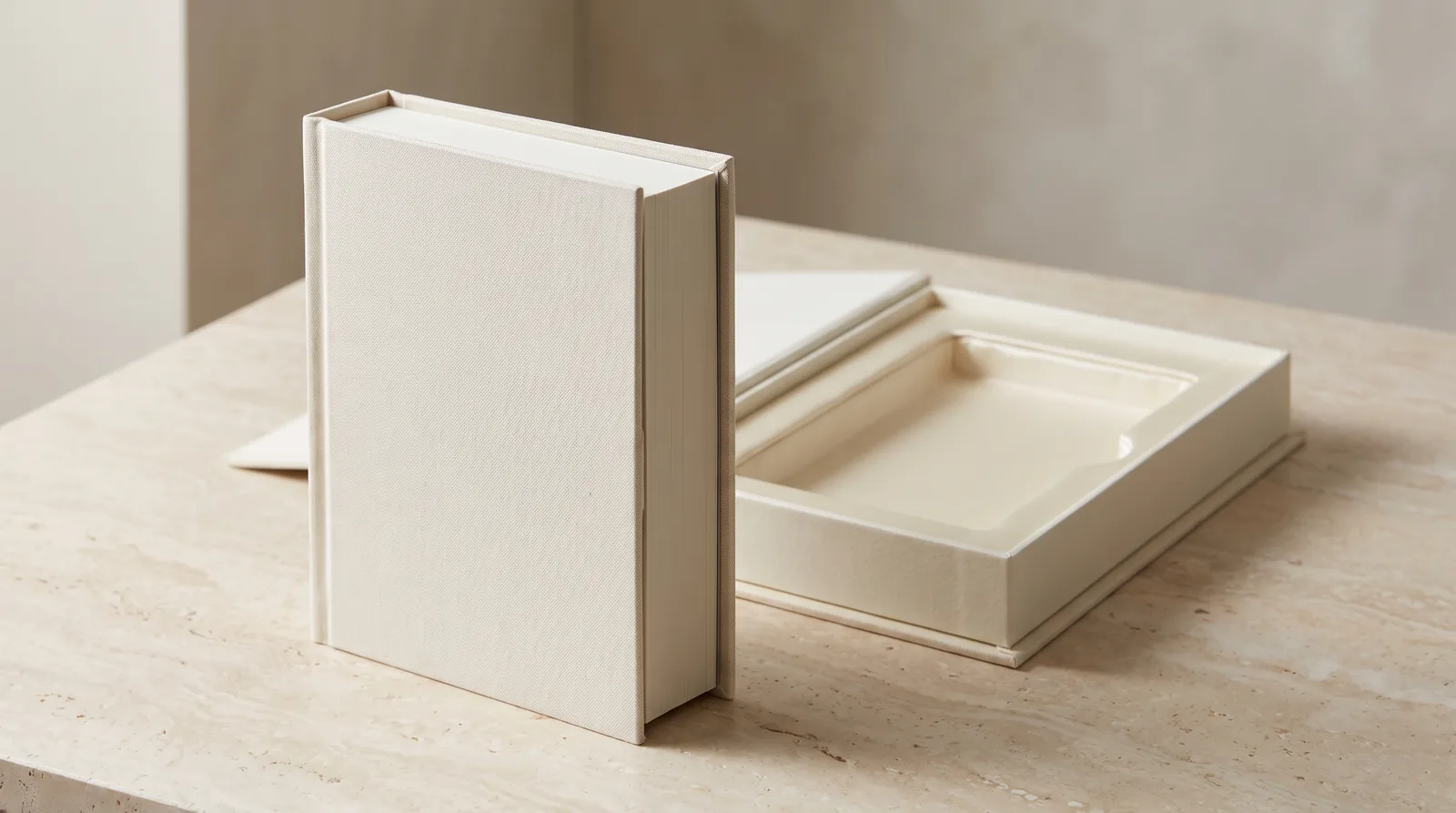
- Rigid boxes ship assembled. A wrapped greyboard box cannot be flattened without breaking the wrap, so it travels as a finished three-dimensional object, and it carries its own internal air across the ocean.
- Carrier bags ship flat, and are among the most freight-efficient items in the category.
- Nested and telescoping structures sit in between, and reworking a structure at design stage can recover a useful part of the difference.
The practical consequence: if freight is a material part of your landed cost and the brief is not committed to a rigid structure, a folding carton with a heavy board and a good finish can deliver much of the same shelf presence at a fraction of the freight. If the brief genuinely calls for a rigid box, the freight is simply part of what that format costs, and it is better to know that at design stage than at invoice stage.
A worked example: 5,000 rigid boxes
Take a magnetic-closure rigid box measuring 250 by 250 by 100 millimetres, which is a common size for a beauty or spirits gift set. Assembled, each box occupies 0.00625 cubic metres. Five thousand of them occupy about 31 cubic metres before any allowance for the shipping cartons they travel in, so call it 34 to 36 in practice.
At the LCL rates above, that is somewhere between roughly 1,400 and 4,500 US dollars of sea freight, and it is more than a 20ft container will comfortably take. The same 5,000 units as flat-packed folding cartons would occupy closer to 4 cubic metres. Same order value, same factory, same route, and a freight bill that differs by roughly eight times.
We publish this because it is the single most useful thing a buyer can know before approving a structure. We would far rather you knew it now than found it on the invoice.
How long does each method actually take, door to door?
These are our own published figures, measured from the moment you approve the pre-production sample, and they include production rather than transit alone. Most freight quotes you receive elsewhere describe only the ocean or air leg, which is why projects planned against them run late.
| Destination | By sea | By air cargo | By express |
|---|---|---|---|
| Europe | 8 to 11 weeks | 6 to 8 weeks | 5 to 7 weeks |
| United States | 11 to 15 weeks | 6 to 8 weeks | 5 to 7 weeks |
Add 7 to 10 days before any of this for the pre-production sample to be made, plus courier transit to you. The gap between sea and air is much narrower than most buyers expect, because production dominates the timeline. Air freight buys you three to seven weeks on a US delivery, not three months.
What is not included in a freight quote?
Freight rates cover the movement of the cargo and very little else. The items below are quoted separately, and they are where landed-cost estimates go wrong:
- Import duty and VAT or sales tax at destination, assessed on the declared value and the commodity code.
- Customs clearance and brokerage fees.
- Destination port charges and terminal handling.
- Final-mile delivery from port or airport to your warehouse.
- Insurance, a small percentage of cargo value and worth taking.
- Storage or demurrage if the shipment is not collected promptly.
The cleanest way to avoid surprises is to ask for the price on DDP terms, which means delivered duty paid: one number, to your door, with duties and clearance included. We quote all incoterms, and we say which one a quotation is on. A quotation that does not name its incoterm is not comparable to one that does.
Can one order be split across methods?
Yes, and for a launch it is usually the right answer. A common pattern is to send 10 to 20 percent of the run by air so the launch, the press samples and the photography are covered, and the balance by sea to arrive for the main sell-through. A single order can also be split across destination countries, and stock can be warehoused and released in stages rather than landing all at once.
Splitting costs a little more in handling and paperwork than a single consignment. It costs considerably less than air-freighting an entire run because one date moved.
What actually reduces the freight bill
- Design for flat-pack where the brief allows it. This is worth more than every other item on this list combined.
- Size the structure to the product rather than rounding up. Ten millimetres of unnecessary depth across 5,000 boxes is real cubic metres.
- Consolidate orders. One shipment of 4 CBM is cheaper than four of 1 CBM.
- Book sea freight outside the pre-Chinese New Year and pre-Christmas peaks, when rates and transit times both rise.
- Quote DDP and compare like with like, rather than comparing an EXW price against a delivered one.
- Decide the freight method at design stage, not after production. By then the volume is fixed.
Ready to start?