Reference
Foil stamping on packaging: hot, cold and holographic, and the line weights that hold
Foil is a metallic film pressed onto board by a heated die, and 0.2mm is the finest line it holds reliably. That single limit decides more foil jobs than the choice of colour. It comes from what foil is: a material laid down rather than an ink printed, so it behaves like a thin sheet. Below is how hot foil works, when cold foil is the better call, and what to put in the brief.
By the Luxel Pac team · 7 min read · Updated September 2026
What is foil stamping?
Foil stamping presses a thin metallic film onto board with a heated die, held there for a fraction of a second. The foil arrives on a roll in several layers: a clear carrier, a release coat, the colour, a vacuum-deposited metal layer and a heat-activated adhesive. The die melts the adhesive only where the artwork is raised, and the foil bonds there. The carrier then peels away, taking the rest of the foil with it. Hot foil stamping and foil blocking are two names for the same process.
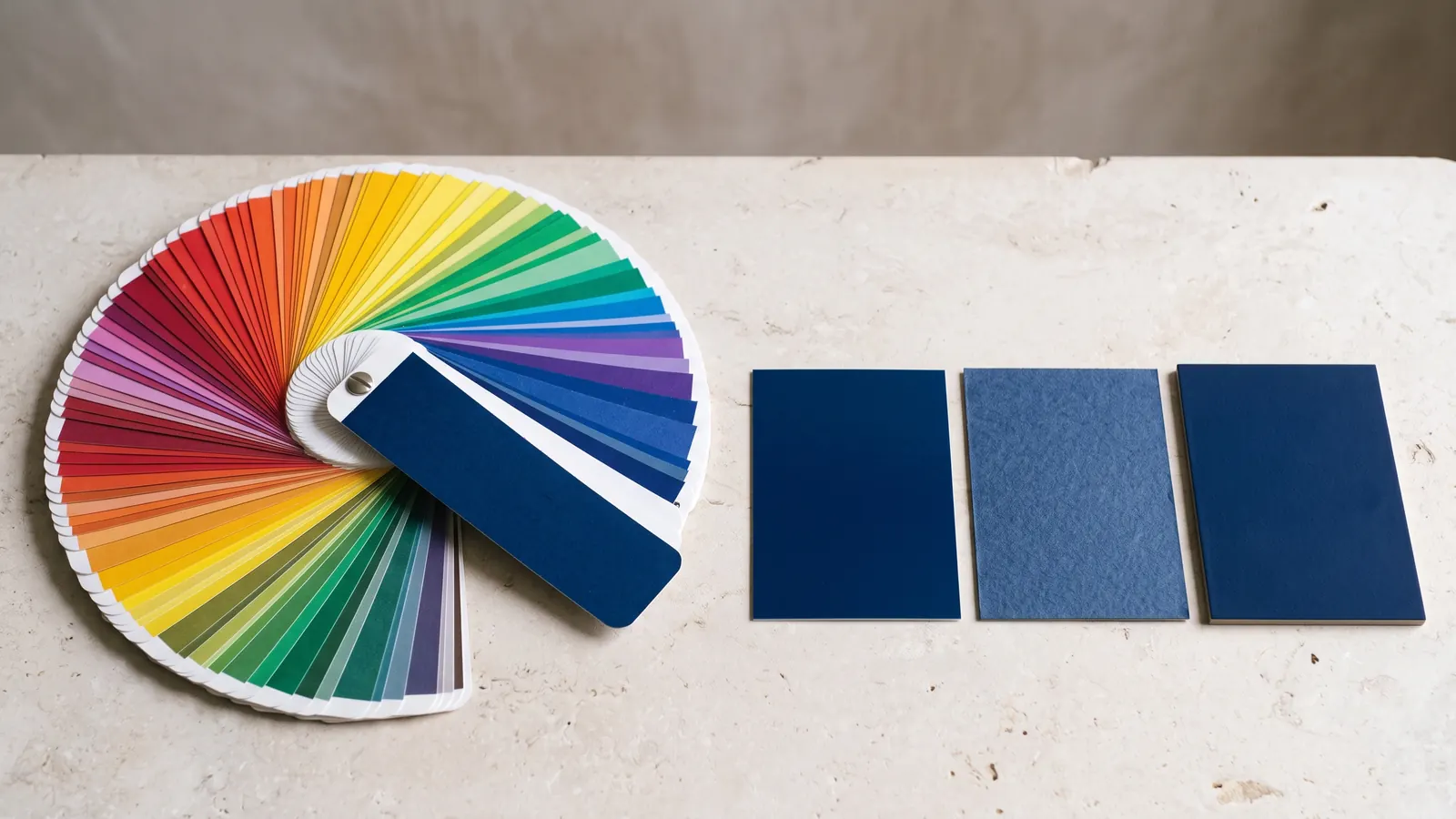
Because foil is a film and not an ink, it reaches a brightness no metallic ink can. It is chosen from a foil range rather than mixed to order. That is also why a gold foil cannot be matched to a Pantone number. Our guide to Pantone colour matching explains how to match the printed colour that sits beside it.
What is cold foil, and how does it differ from hot foil?
Cold foil is applied on the printing press with no heat and no die. An adhesive is printed where the foil should land and the foil is laminated over it. Ultraviolet light then cures the adhesive, so the foil bonds only there. Nothing is cut, so there is no foil tooling. The metallic can be overprinted with ink, which turns a single silver base into any metallic colour.
It gives up brilliance and texture in return. Cold foil reads flatter than hot foil, closer to a bright metallic ink than a mirror. The adhesive needs a smooth coated surface to print cleanly, and the foil cannot be combined with an emboss in the same pass.
| Hot foil | Cold foil | Holographic foil | |
|---|---|---|---|
| How it is applied | A heated die presses foil onto the board | Adhesive printed on press, foil laminated, cured by UV light | As hot foil, with a light-diffracting pattern in the film |
| Foil tooling | A die cut for your artwork | None | A die cut for your artwork |
| Finish | Bright, close to a mirror | Flatter, close to a metallic ink | Shifts colour as the box moves |
| Board | Coated, uncoated and textured | Smooth coated board only | Smooth surfaces read best |
| With an emboss | Yes, in one hit | Separately, never in one hit | Yes, in one hit |
| Overprinted with colour | No | Yes, from a silver base | No |
| Best for | Logos, monograms, lids | Long runs, metallic colour across large artwork | Cosmetics, limited editions |
Choose hot foil for a logo, a monogram or a single metallic mark on a lid, and for any uncoated or textured stock. Choose cold foil when the metallic covers a large printed design or needs several metallic colours at once. Those are the jobs where skipping the die pays off, and the longer the run, the more it does.
What is holographic foil?
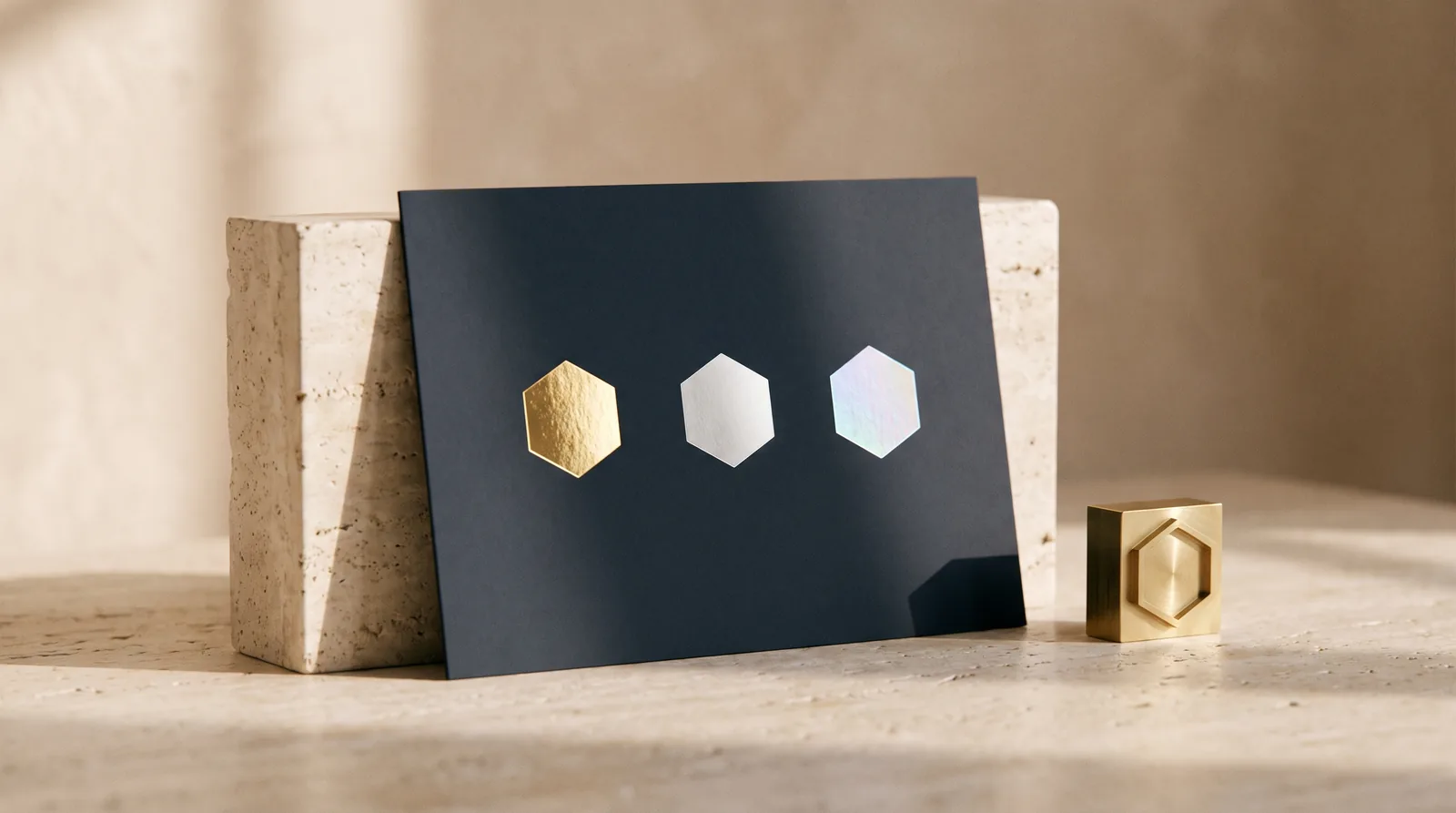
Holographic foil is a hot foil with a fine light-diffracting pattern formed into the film. The mark shifts colour as the box moves in the hand. It is applied with a die like any hot foil, and reads best on a smooth surface where texture cannot break up the pattern. It suits cosmetics, limited editions and seasonal packaging, where the movement is the point.
Which foil colours can you choose?
Metallic foils in gold, silver, copper and rose gold, each in several tones, bright to antique. We also stamp holographic films and matte pigment foils in black, white and solid colours. Every one is chosen from a physical foil range, and the swatch you approve is the one we stamp.
What board and paper take foil well?
Smooth, firm surfaces give the sharpest foil. Texture breaks up the edge of a mark, and a soft stock lets the die sink in, so the foil looks pressed rather than laid.
- Coated boards and smooth art papers: the crispest edges and the brightest shine.
- Soft-touch laminated surfaces: the foil sits well, and the contrast between matte and mirror does the work.
- Uncoated and textured papers: workable with hot foil, with a softer edge. Not suitable for cold foil.
- Linen, cloth and faux leather wraps: take hot foil well at larger sizes. Fine detail breaks on the weave.
- Rigid box wraps: excellent, because the greyboard behind gives the die something solid to press against.
How fine can foil detail go?
A foiled line needs to be at least 0.2mm wide. Below that it breaks up or fails to transfer, and the rougher the board, the more that limit matters. These are the figures to design to:
- Foiled lines: 0.2mm minimum.
- Unfoiled shapes cut out of a foil area, such as the inside of a letter: 0.3mm minimum, because foil floods into narrow gaps. Allow 0.5mm on a long run.
- Text: 8pt for sans-serif faces, 10pt for serifs.
- Hairline serifs, as in Didot or Bodoni at small sizes: these break. Set them larger or choose a sturdier cut.
- Gradients and transparency: foil cannot reproduce either. A foil is on or it is off.
The figures above hold on smooth coated stock with a brass die. A textured wrap needs more margin, so confirm the limit for your board with whoever cuts the die.
Can foil be combined with embossing?
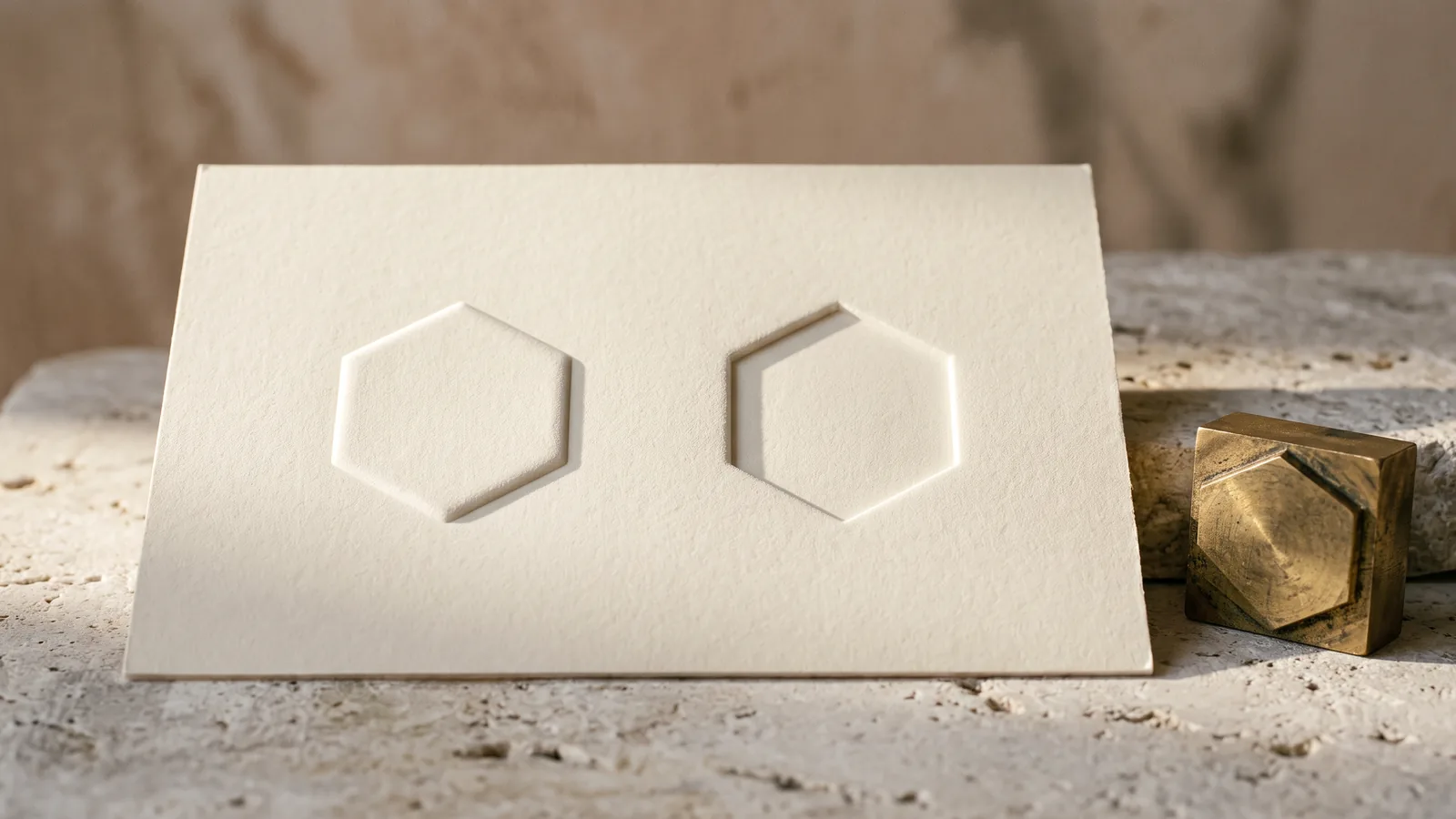
Yes, in a single hit. Combination stamping applies the foil and forms the relief at the same moment. The mark is metallic and raised, and the two cannot drift apart. Doing it as two separate operations risks misregistration, and a metallic mark sitting a fraction off its relief shows at once. Our guide to embossing and debossing covers the relief side in detail.
Is foil packaging recyclable?
Paper mills tolerate a small foiled logo in the fibre stream. They do not tolerate foil across a whole panel, because the metallised layer does not break down with the paper. If recyclability is part of the brief, keep foil to marks rather than surfaces. Our guide to sustainable luxury packaging sets out the rest.
What drives the cost of foil stamping?
The die, and then the area. Most of the variation sits in those two.
The die is a one-time tooling cost that belongs to your artwork and does not recur on a repeat of the same design. Brass holds finer detail and lasts through long runs. Magnesium costs less and suits short runs, with softer edges. After the die, cost follows area, so a restrained mark on a lid costs meaningfully less than foil across a full panel. Each extra foil colour adds a separate pass with its own die.
Cold foil moves the cost rather than removing it. With no die, the tooling disappears. Foil is then consumed across the whole printed area on press, which favours long runs and large metallic designs over a single small mark. Our guide to what luxury packaging costs sets out how the rest of a quotation is built.
What to specify
- Hot or cold foil, and on which panel.
- The foil colour, named from the foil range and not as a Pantone number.
- Whether it is combined with an emboss. If it is, ask for one-hit combination tooling.
- Registered to printed artwork, or standalone.
- The finest line and the smallest text in the artwork, at final printed size.
- Any unfoiled shapes inside a foil area, and how wide they are.
- The board or wrap, since cold foil needs a smooth coated surface.
We proof foil on the actual board before production. A foil that looks crisp on screen can fill in on a textured wrap or lose its shine on a soft stock. Neither shows until you hold the proof.