Reference
Embossing and debossing on packaging: what holds, what fills in, and what it costs
Embossing is the finish clients ask for by name and describe by feel. It is also the one most frequently specified in a way that cannot be made: a hairline serif that will flatten, a mark placed across a fold, an emboss on the front of a carton with nobody thinking about what appears on the back. None of that is difficult to avoid, but it has to be decided at artwork stage, because a die is cut once.
By the Luxel Pac team · 7 min read · Updated August 2026
What is embossing?
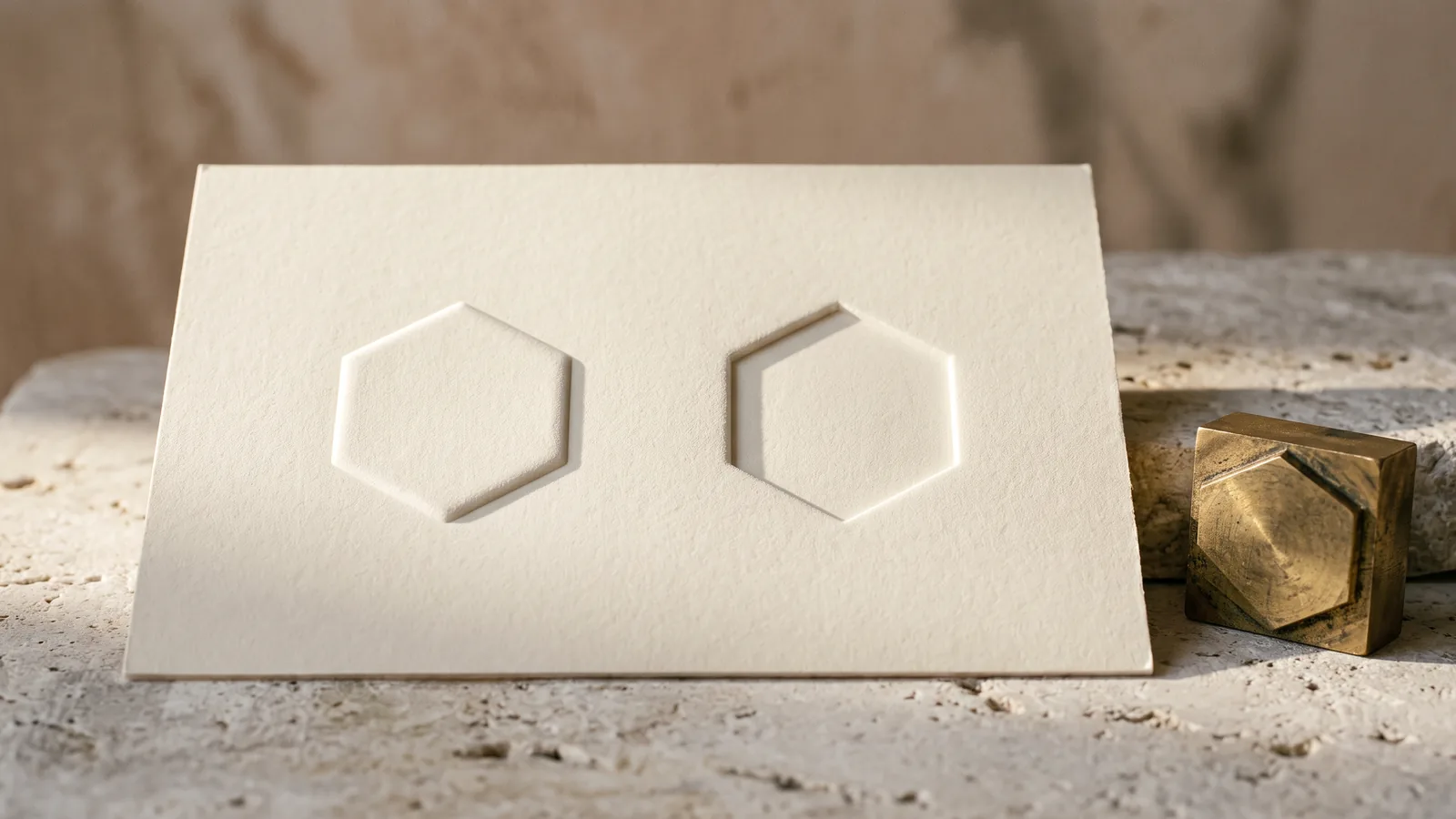
Embossing raises an area of board above the surface by pressing it between two dies, a raised male die and a recessed female die, under heat and pressure. No ink is involved. The shape is formed in the material itself, which is why it survives handling and why it reads by touch before it reads by sight.
What is debossing?
Debossing is the same process in reverse: the mark is pressed down into the board rather than raised out of it. The tooling is the mirror image and the cost is the same.
Which to choose is a question about light rather than preference. An emboss catches light on its raised edges and casts a small shadow, so it announces itself across a room. A deboss collects shadow inside the recess and is quieter, closer to a maker’s stamp. On dark board a deboss reads better. On pale uncoated stock an emboss wins.
What is blind embossing?
Blind embossing means the impression carries no ink and no foil. Just the shape in the board. It is the most restrained version of the finish and, on a good uncoated stock, the most expensive-looking, because there is nothing to look at but the material and the making.
What is foil embossing, and how does it differ from foil stamping?
Foil stamping lays a metallic film flat onto the surface. Foil embossing, sometimes called combination stamping, applies the foil and forms the relief in a single hit, so the mark is both metallic and raised.
Doing it in one pass matters. Foiling first and embossing afterwards as two operations risks the two falling out of alignment, and misregistration on a metallic mark is very visible. If a brief calls for a raised metallic logo, ask specifically for combination tooling rather than two separate processes.
| Finish | What it does | Reads best on | Tooling |
|---|---|---|---|
| Blind emboss | Raised, no colour | Pale uncoated board, textured stocks | Die pair |
| Blind deboss | Recessed, no colour | Dark or heavily coloured board | Die pair |
| Foil stamp | Flat metallic film | Any smooth surface | Single die |
| Foil emboss (combination) | Metallic and raised in one hit | Statement marks, lids | Combination die, costs more |
What is a registered emboss?
A registered emboss is aligned to something already printed, so the relief sits exactly on top of the artwork rather than beside it. It is the difference between a logo that looks sculpted and one that looks stuck on.
It is also the version most likely to disappoint, because it depends on how tightly the press and the embossing station hold registration across a run. Ask any manufacturer what registration tolerance they hold before specifying a registered emboss on fine artwork. If they cannot answer in millimetres, expect drift.
What board and paper emboss well?
Thickness and give are what matter, not price. A heavier uncoated board with some softness takes a deep, crisp impression and holds it. Thin coated stock resists the die, gives a shallower result, and can craze the coating along the edges of the mark.
- Uncoated boards and textured art papers: the best results, deepest impression, most tactile.
- Coated stocks: workable, shallower, and the coating can crack on tight radii.
- Soft-touch laminated surfaces: emboss beautifully and feel exceptional, but the raised edge is the first place a box scuffs in transit.
- Very thin cartonboard: risks cracking or showing through as a defect rather than a feature.
- Rigid box wraps: excellent, because the greyboard behind gives the wrap something to form against.
What is the mark on the back?
Every emboss displaces material, so a corresponding indent appears on the reverse of the sheet. This is the single most common surprise on a finished job, and it is physics rather than a fault.
On a rigid box it is invisible, because the wrap is mounted to greyboard and the reverse is never seen. On a folding carton the reverse is the inside of the box, and an emboss on the front panel will show as a dent inside. Sometimes that is fine. Sometimes the inside is printed and it is not. Decide which before the die is cut, not after.
What will not emboss cleanly?
- Hairline strokes and fine serifs. As a rule of thumb, strokes much below half a millimetre tend to flatten out; confirm the limit with whoever is cutting the die.
- Small text. A logo that works at 30mm may be unreadable at 8mm once the edges soften.
- Anything crossing a crease or fold. The board has to bend there, and an emboss stiffens it.
- Large flat areas. A big unbroken raised panel looks bowed rather than crisp. Broken or multi-level shapes hold their form.
- Tight internal corners, which round off as the board forms.
How much does embossing cost?
Two separate numbers. Most briefs account for one and are surprised by the other.
The die is a one-time tooling cost that belongs to your artwork and does not recur on a repeat of the same design. Brass holds finer detail and lasts longer than magnesium, and multi-level or sculpted dies cost more because they are cut in stages rather than in one profile.
The finish itself typically adds 5 to 10 percent to unit cost, in line with the other finishes, and what moves it within that band is the area covered rather than the technique. A restrained mark on a lid costs meaningfully less than the same treatment across a full panel. Three finishes together land nearer 15 to 30 percent above the unfinished piece, not triple it. Our guide to what luxury packaging costs sets out how the rest of the quotation is built.
What to specify
- Emboss or deboss, and on which panel.
- Blind, or combined with foil. If combined, ask for one-hit combination tooling.
- Registered to printed artwork, or standalone.
- Depth and profile: single level, or multi-level and sculpted.
- What happens on the reverse, and whether that face is seen.
- The smallest element in the artwork, so the die maker can tell you what will survive.
We proof this on the actual board before production, because an emboss is one of the few finishes that cannot be judged from a flat visual. Depth and edge quality are things you have to hold.