Reference
Die cutting in packaging: the die line, what a die costs, and who owns it
Search for die cutting and half the answers are about scrapbooking. This one is about packaging: the steel tool that cuts and creases a sheet of board into the flat shape that folds up into your box. It is the first thing a manufacturer commissions and the last thing anyone thinks to ask about, which is a problem, because approving a die line commits you to a physical tool and changing your mind afterwards means paying for another one.
By the Luxel Pac team · 5 min read · Updated August 2026
What is die cutting in packaging?
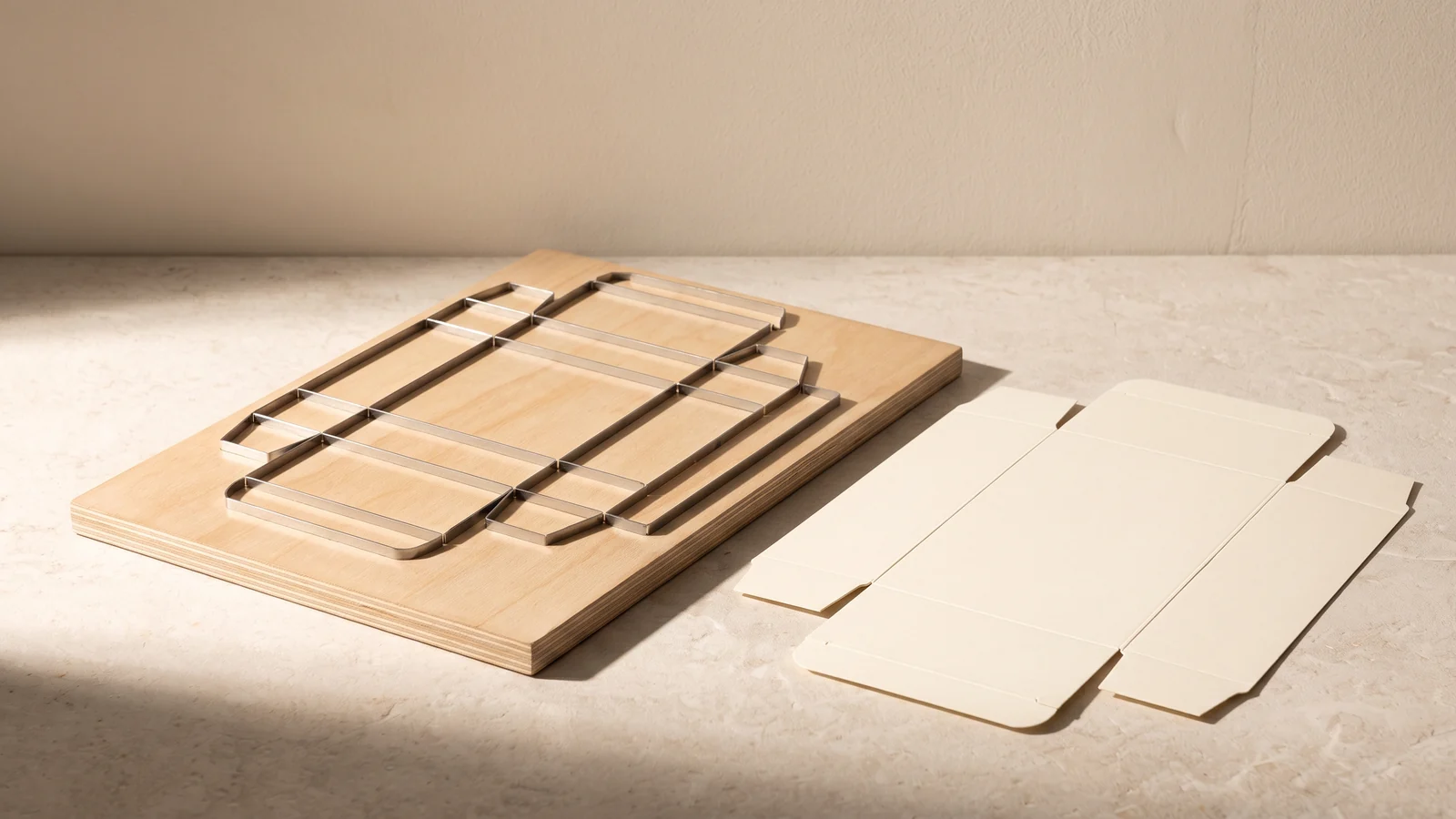
Die cutting is how a flat sheet of board becomes a box shape. A steel blade, bent to the outline of your design and set into a plywood base, presses through the sheet under pressure. Blunter blades on the same tool press creases where the board will later fold.
The cut and the crease happen in one stroke. The waste does not: the internal offcuts are pushed out at a separate stripping station afterwards, and the finished blanks are then separated from one another. That is why a die cutting quotation sometimes lists more than one operation.
What is a die line?
A die line is the flat outline of your box, drawn to scale, showing every cut and every crease before anything is made. It is the drawing your designer works on top of, and it is the specification the tool is built from.
It is worth treating the die line as the point of no return, because it is. Once the forme is cut, the dimensions are fixed in steel. Changing a panel by five millimetres afterwards is not an edit, it is a new tool. We send a die line for approval before anything is made, and a physical sample after, because a drawing on screen and a folded box in your hand are different objects.
How much does a cutting die cost?
For our rigid boxes it is about 200 US dollars, and we confirm it per project because size and complexity move it. A very large box or an unusual structure costs more. It is a one-time charge that belongs to your design and does not recur when you reorder the same box.
That figure is worth putting next to what a general answer will tell you. Search for die costs and you will find figures running into thousands, because most of those answers describe injection moulding tools or metal stamping dies, which are a different industry. A steel rule cutting forme for paperboard is a modest cost, and on a run of 5,000 units we deduct it from the order entirely.
Spread across a first run of 1,000 boxes, 200 dollars is 20 cents a box. That matters at the minimum and disappears above it, which is the opposite of what most buyers expect and one of several places where packaging economics are counterintuitive. Our guide to what luxury packaging costs covers the rest.
Who owns the die once you have paid for it?
You do. The tooling is yours, it is specific to your design, and we hold it for your reorders.
The honest caveat, which is rarely mentioned: a die does not travel as easily as buyers assume. Formes are built to the press they run on, so moving one to another manufacturer usually means it does not fit their machine and a new tool gets made anyway. Ownership is real, portability is limited. Anyone who tells you a die moves freely between factories is describing a simpler world than the one we work in.
The practical consequence is that tooling is not the thing that locks you to a supplier, and it should not be treated as leverage by either side. At roughly 200 dollars it is too small to be a lock-in. Judge a manufacturer on the work.
Which packaging needs a die and which does not?
| Format | Needs a cutting die? | How it ships |
|---|---|---|
| Folding cartons | Yes. Cut and creased in one pass on a flatbed press | Flat |
| Rigid boxes | Yes. The greyboard is cut, and the printed wrap is cut to its own line | Assembled |
| Luxury paper bags | Yes, for the blank and the handle punch | Flat |
| E-commerce mailers | Yes | Flat |
| Tissue, wraps, thin paper items | No | Flat |
The rigid box is the one people get wrong. Because it is finished largely by hand, buyers assume no tooling is involved. In fact it needs two cut components, the board structure and the wrap, and the hand work happens after the cutting rather than instead of it.
What should I check before approving a die line?
- That the internal dimensions fit the product with the tolerance you need, not the external dimensions, which is the more common mistake.
- That artwork extends past every cut line, so a small shift on press does not leave a white edge.
- That fold panels run with the grain of the board where possible. Creasing reduces cracking on a fold but does not eliminate it, and creasing across the grain is where cracks appear.
- That nothing important sits close to a crease or a cut, because both move slightly.
- That you have seen a folded physical sample, not only the flat drawing.
On tolerance specifically, ask your manufacturer what they hold and whether it is measured on the production run or only on the first sheet. We would rather tell you to ask the question than publish a number we have not verified across every facility and format we work with.
Ready to start?